Grex: connecting science and art through a slime mould from the undergrowth
Cooperation is one of the fundamental principles of life. In the slime mould Dictyostelium discoideum, thousands of individual cells communicate and self-organise to form a multicellular structure known as a Grex. This remarkable stage of the organism’s life cycle gave its name to Grex, an audiovisual collaboration between scientists and artists.
The project brings together recordings captured in Jitka Čejková’s laboratory at the University of Chemistry and Technology Prague, music by composer Joshua Borin, and a performance by pianist Hannah Watson Emmrich. The resulting work forms part of Hannah’s debut album Notes from the Undergrowth, a musical journey through a forest ecosystem inspired by both familiar and often overlooked forms of life. While other pieces on the album explore birds, mushrooms, fireflies, and trees, Grex turns its attention to a much smaller inhabitant of the forest floor.

We asked Jitka Cejkova, working group member, to tell us about this beautiful example of what can grow from curiosity, patience, and the unexpected connections that science makes possible.
How did the idea start?
The initiative emerged from connections established through the COST Action EuroCurvoBioNet, which stands for European Curvature and Biology Network. By bringing together researchers from biology, mathematics, physics, engineering, and materials science, the network explores how geometry and curvature influence living systems across scales. Just as shape and curvature help organise biological structures in nature, EuroCurvoBioNet helps forge new connections across disciplines, creating bridges between scientific communities and fostering new forms of collaboration.

From single cells to a multicellular organism
The opening microscopy sequences of Grex capture Dictyostelium developing on a nutrient-free agar surface in the laboratory. The cells shown in the recordings have already entered the developmental phase triggered by starvation. In nature, these amoebae normally live in the soil and feed on bacteria. Once this food source is exhausted, they begin communicating via pulses of cyclic adenosine monophosphate (cAMP), a signalling molecule that propagates through the population as travelling waves and coordinates their movement.
Guided by these chemical signals, individual amoebae assemble into characteristic streams converging on aggregation centres. The resulting aggregates develop into mounds and later into the so-called standing slug. This structure eventually topples onto the substrate and becomes a migrating slug, also known as a Grex or pseudoplasmodium, which searches for suitable conditions before developing into a fruiting body.
In an extraordinary act of cellular cooperation, some cells sacrifice themselves to form the stalk that elevates the structure, while others become spores. Protected by a durable outer coat, these spores can survive adverse conditions for extended periods before eventually giving rise to new amoeboid cells and restarting the cycle. Under laboratory conditions, this entire developmental journey takes approximately 24 hours. Through time-lapse recordings, Grex compresses this slow biological choreography into a timescale that can be experienced alongside the music, making the emergence of multicellular form visible to the viewer.
Curvature across scales
For biologists, Dictyostelium has long served as a versatile model organism for investigating numerous biological questions, from cell communication and differentiation to the evolution of multicellularity. For physicists and mathematicians, it is equally fascinating because the propagating cAMP waves generate striking spatial patterns, including target waves and rotating spirals, similar to those observed in other excitable systems, ranging from the Belousov–Zhabotinsky reaction to electrical wave propagation in cardiac and neural tissue.
The latter sections of Grex reveal these collective signalling dynamics across entire cell populations spread over several square centimetres. Using a specialised optical imaging technique, the cAMP waves responsible for coordinating aggregation become visible across the developing population. Some sequences have been digitally enhanced to make these dynamic patterns easier to observe.
Video credits: Laboratory recordings by Jitka Čejková (University of Chemistry and Technologu Prague). Music: Grex by Joshua Borin. Performance by Hannah Watson Emmrich. Featured on the album Notes from the Undergrowth (Deux-Elles, 2026)
Created for research rather than artistic purposes, these recordings were used to investigate how chemical signalling coordinates aggregation and how external compounds can influence wave propagation and pattern formation. For EuroCurvoBioNet, they provide a compelling example of how geometry emerges across scales, from the changing shapes of individual amoebae to spiral wave patterns spanning entire populations and ultimately the three-dimensional form of the slug and fruiting body. In this sense, Dictyostelium offers a vivid illustration of the interplay between geometry, communication, and self-organisation that lies at the heart of questions first explored by D’Arcy Thompson in his influential book On Growth and Form more than a century ago.
How does connecting science and art improve knowledge in your field?
One of the challenges facing modern science is communicating complex ideas beyond specialist communities. Many areas of research rely on advanced mathematics, sophisticated experimental methods, powerful imaging techniques, and highly technical language. In D’Arcy Thompson’s era, scientific ideas often reached wider audiences through books. Today, how people encounter knowledge has changed dramatically, with scientific content competing for attention alongside a constant stream of digital media, images, videos, and social networks. Projects such as Grex demonstrate how artistic expression can complement traditional science communication, offering new ways to explore and experience scientific ideas.
Watching the life cycle of Dictyostelium unfold alongside Joshua Borin’s music creates an experience that is very different from viewing the recordings alone. The music provides emotional meaning and structure to processes that might otherwise appear abstract, while the images give visual form to ideas that listeners might struggle to imagine from sound alone.
By combining scientific imagery, music, and storytelling, projects such as Grex create new points of entry into science for audiences who might never encounter these topics through traditional scientific communication. Rather than simplifying science, such collaborations reveal its deeply human dimension: curiosity, creativity, wonder, and our fascination with how life organises itself.
Reaching new audiences
Beyond Grex: science communication in EuroCurvoBioNet
The collaboration behind Grex is just one example of how EuroCurvoBioNet seeks to connect scientific research with wider audiences. Alongside its scientific activities, the network places a strong emphasis on education, outreach, and public engagement. Under the leadership of Action Chair John Dunlop and Vice-Chair Łucja Kowalewska, and with the support of Science Communication Coordinator Cécile Bidan, EuroCurvoBioNet develops a wide range of initiatives designed to share scientific ideas beyond academic communities.
These activities include webinars, podcasts, social media outreach, scientific image competitions, and educational resources. The annual image competition showcases striking examples of curvature in biological systems, highlighting how scientific observation can inspire both scientific understanding and aesthetic appreciation. Selected images are featured in an online gallery on the EuroCurvoBioNet website, creating a growing visual collection of curvature-related phenomena across biological scales. Researchers with compelling images are warmly encouraged to contribute to future editions.
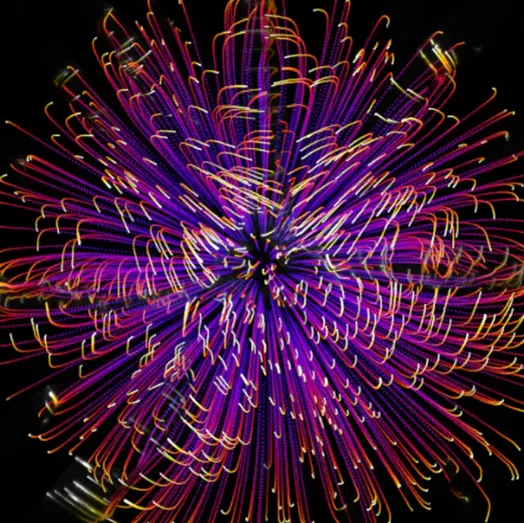
Firework of beads to study biofilm spreading – Cecile Bidan – Max Planck Institute of Colloids and Interfaces
Another important initiative is the EuroCurvoBioNet Teaching & Outreach Toolbox, curated by Michał Bykowski. Developed following a dedicated outreach workshop held in Prague in 2025, it provides experiments, animations, image collections, games, and 3D models designed to make concepts related to geometry and biology accessible to students, teachers, and the general public. These resources are regularly used at science festivals and other public engagement events across Europe. The network also maintains a Virtual Toolbox offering open access to imaging, image-analysis, and mathematical tools for studying curvature–biology interactions across scales.
What impact do you hope to achieve?
Through projects such as Grex, educational activities, and open research resources, EuroCurvoBioNet aims to foster the same principle that lies at the heart of the slime mould’s life cycle: meaningful forms emerge through interaction. Whether between cells, scientific disciplines, or between science and art, collaboration can generate possibilities that no single component could achieve alone.
Additional information
View the COST Action webpage on this website.
Visit the networks’s website www.curvobio.com.
Follow the EuroCurvoBioNet network on LinkedIn and Bluesky, and listen to their podcast series CurvoBio on Spotify