Fish Superpowers!
A comic series to engage with young minds
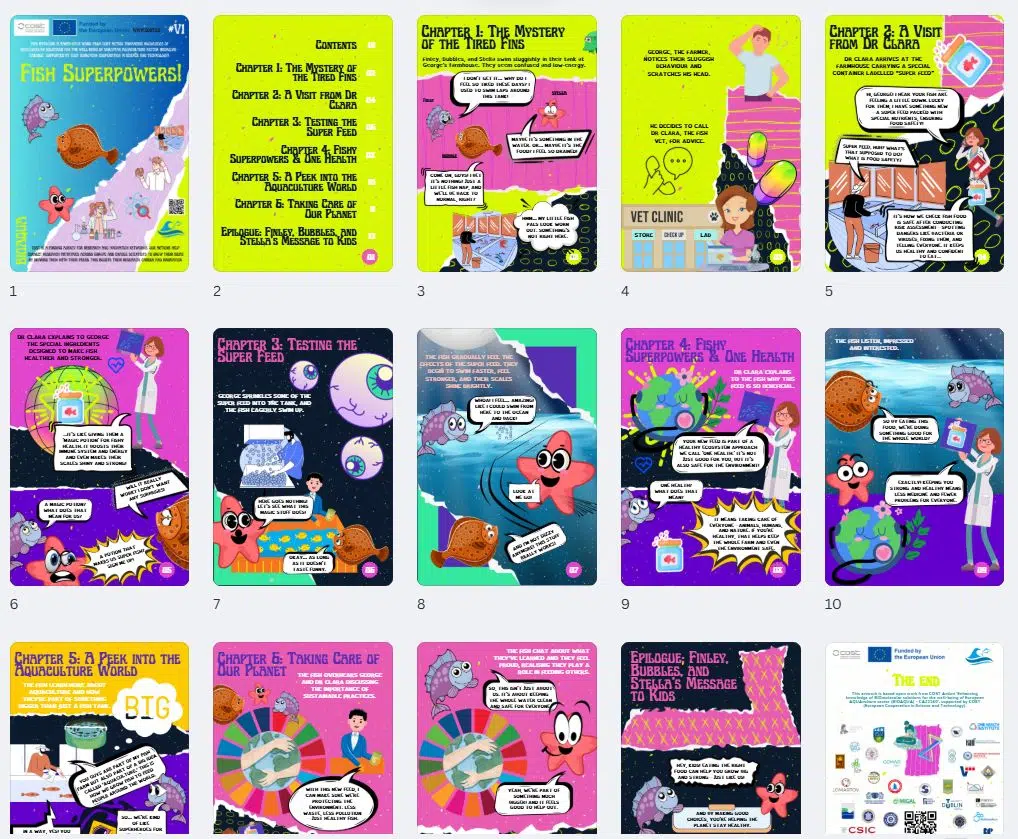
BioAqua’s aquaculture journey is set to inspire a new generation. In 2025, BioAqua: Enhancing knowledge of Biomolecular solutions for the well-being of European Aquaculture sector, launched Fish Superpowers!, an educational comic series created to introduce schoolchildren to the exciting and vital world of aquaculture. Through vibrant characters, fun adventures, and imaginative storytelling, the series brings fish health, sustainable aquaculture, and the science behind aquatic ecosystems to life, making complex concepts accessible and engaging for young readers. This comic aims to simplify complex scientific concepts into playful, accessible adventures for children.

We asked Dr Rajat Nag, leader of the fish welfare, horizontal Working Group and Assistant Professor at University College Dublin.
Where did the idea for a comic series come from?
I prepared a comic in the past for the MSCA ‘PROTECT’ Training Network, which developed and integrated modelling capabilities to assess the effects of climate change on food safety. This comic is aimed at primary school children, ages 6 and above, to illustrate the main concepts and outcomes of the PROTECT Training Network in an uncomplicated and fun way. The coordinator, Professor Enda Cummins (UCD), was also contacted regarding the comic’s success. Over 1,400 views, 688 downloads, and reaching thousands of students with its hard copy at educational fairs across Europe. Therefore, we wanted to follow the same template for the BioAqua COST Action as well.
Did you already have any experience with creative writing or illustration?
Yes, I studied painting and fine arts for 9 years, including watercolour, acrylic, oil, and pencil and charcoal. Due to time limitations, I spend time on photography nowadays. But whenever I have a chance to contribute to scientific illustration, I utilise my skills, and it is a great escape from conventional research to spend some time with fine arts and interact with kids. During the process, I also get feedback from kids and students to make it more interactive.
How did you find the process of mixing art, creative writing, and your scientific knowledge?
The process followed these steps:
- Conduct a kick-off meeting to share the idea with COST partners.
- Develop a story backbone with a schematic and write an abstract on the overall message to be delivered.
- Next, bring out the elements (branches) from the story backbone as chapters.
- Based on the COST partners’ scientific knowledge, distribute the load among the experts.
- Once the partners have developed the scientific idea (one page), assemble all the chapters into a single document.
- Simplify the scientific terms and rewrite the story.
- Identify potential characters of the comic
- Write scripts/conversation for each character.
- Follow the sequence and start working on the comic with text boxes for alignment.
- Introduce characters to fill the space of the comic.
- Add background to pages or follow a template via the software available on the market.
- Revisit the comic again and again by incorporating feedback from the COST partners and their kids.
- Finalise it and download to versions as PDF (CMYK for print, RGB for digital use).
This is the overall process.
How can public engagement and science communication projects like this improve our understanding of aquaculture?
Public‑engagement tools such as the BioAqua comic improve understanding of aquaculture by turning technical science into clear, engaging stories. The comic simplifies complex ideas; for example, food‑safety risk assessment is explained as “spotting dangers like bacteria or viruses, fixing them, and telling everyone”, making the concept approachable for non‑experts. By giving the fish personalities and showing their transformation – “I feel… amazing!” – it helps readers connect emotionally with topics such as immunity, nutrition, and sustainable feed.
To date, it has 180 views and 126 downloads, and our Italian partners at the Istituto Zooprofilattico Sperimentale delle Venezie (IZSVe) have printed hundreds of copies and distributed them to school students at educational fairs. Future work may involve translating it into different languages if funding is available.
BioAqua COST Action
Over the past decade, the aquaculture sector has witnessed a growing demand for innovative technologies to enhance sustainability, resilience, and productivity. Responding to this challenge, a research network seeks to unlock the potential of biomolecular solutions to support the future of European aquaculture, advancing novel approaches for veterinary applications, traceability systems, diagnostics, and biosafety.
Video on SciTube: How Biomolecular Solutions Can Make Fish Farming Sustainable
To achieve this vision, the BioAqua COST Action is establishing a dynamic and interdisciplinary European network bringing together researchers, aquaculture industry representatives, policymakers, and other key stakeholders. The initiative has been conceived to facilitate knowledge exchange, foster collaboration, develop a shared research agenda, and stimulate cutting-edge research and innovation across the sector.
In its first two years, the network has made substantial progress towards advancing aquaculture through sustainable biomolecular solutions. By promoting innovative technologies for biosecurity and fish welfare, the Action is contributing to improved fish health and quality, enhanced animal welfare, greater farm productivity, and reduced environmental impact.
Key achievements include the ongoing development of a shared Data Lake on biomolecular solutions, which will support a future position paper on sustainable biosecurity practices. The network has also organised several topic-specific Webinars, two High-Performance Workshops, with further editions planned for 2026 and 2027, fostering knowledge exchange among researchers across Europe. In addition, all Working Groups have participated in a technology foresight exercise to identify emerging scientific and technological trends aligned with BioAqua’s vision. Together, these activities highlight a forward-looking approach to sustainable aquaculture health management.
Further information
View the COST Action webpage
Read about other science communication best practice examples