Teaching the Universe
By observing the universe, we can compare our theories with the facts. Yet reconciling theoretical expectations with reality has become increasingly challenging, as different measurements of the same quantity often yield conflicting results, much like two builders disagreeing on a door’s size. If similar discrepancies emerge in other measurements, the integrity of the entire framework could be called into question.
The growing discrepancies between measurements obtained by different teams are creating significant tensions within the current cosmological model and call for a concerted effort to uncover their origin. Are these differences rooted in the way observational data are collected? Do they arise from the methods used to analyse the data? Or do they point to limitations in the theoretical framework employed to interpret the observations?
By bringing together experts in these three complementary areas, a network of researchers named CosmoVerse COST Action, Addressing observational tensions in cosmology with systematics and fundamental physics, aims to advance our understanding of one of the most important open challenges in modern cosmology: the origin and significance of these tensions.
Why Cosmology? What is CosmoVerse?
Training is key – For researchers
To foster the cross-disciplinary development of early-career researchers, a dedicated webpage was created showcasing the key toolkits and resources at the heart of the cosmic tensions community.
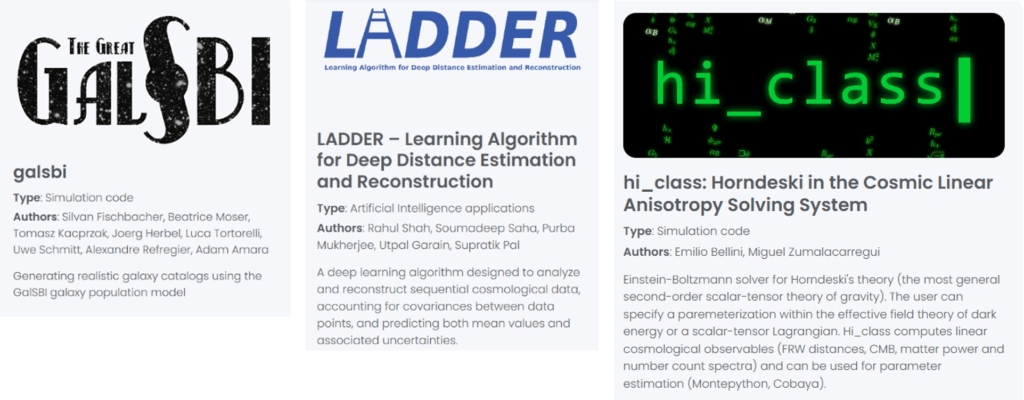
This effort is further supported by a series of online training sessions that introduce students to both the theoretical foundations and practical applications of these toolkits within their respective research domains. While participation in the live school is necessarily limited to those able to attend in person, the recorded sessions and accompanying materials extend these learning opportunities to a much broader audience.
CosmoVerse Training Series: Matteo Martinelli: Model independent deviations from General Relativity
For the new generation of cosmologists!
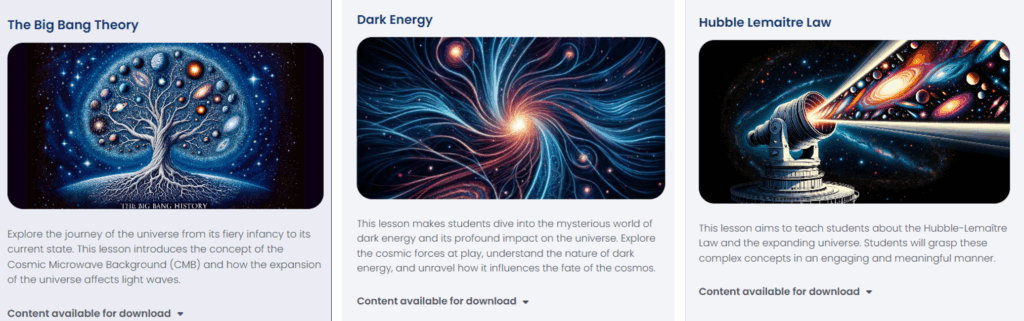
The public engagement and educational dimensions of cosmic tensions have been strengthened through activities developed by the CosmoVerse Action, including dedicated outreach events, publications aimed at broader audiences, and educational resources that educators can use to introduce and explore the topic in the classroom. The Big Bang, Hubble-Lemaitre Law, the Cosmic Redshift, Geometric Gravity, Dark Matter, and Dark Energy.
The CosmoVerse series of lessons was created for teachers to help them teach the basics of astrophysics.
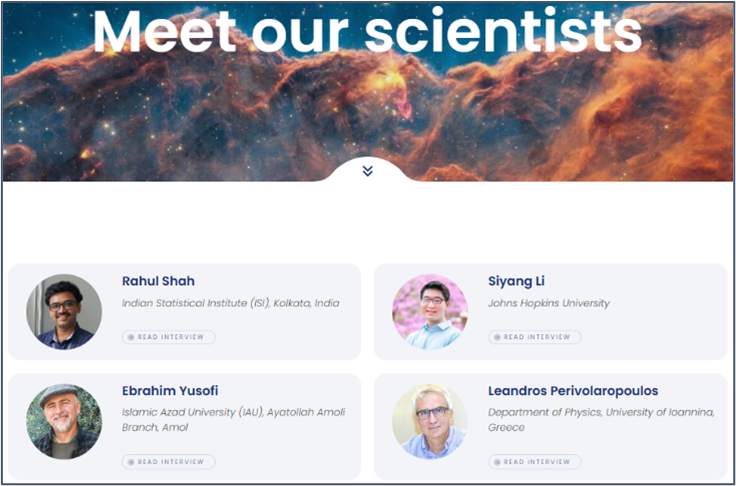
Each lesson includes guidance and supporting materials for teachers, alongside a CosmoVerse adventure presented as an interactive dialogue between the teacher, students, Quark, and renowned scientists – Meet our scientists.
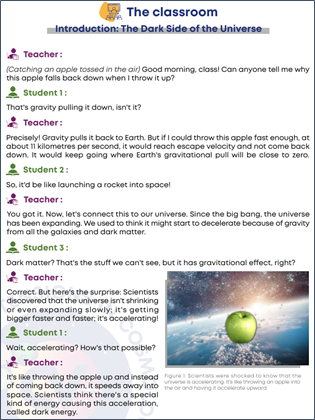
Through these materials, the network seeks to inspire curiosity and enthusiasm for astrophysics and cosmology while empowering the next generation of researchers to tackle the outstanding challenges posed by cosmological tensions.
We asked Prof. Gonzalo Olmo, Science Communication Coordinator of the Action, and Prof. Jackson Levi Said and Prof. Eleonora di Valentino, Action’s co-Chairs, to tell us about the initiative.
Where did the idea of teaching the universe come from?
Our network holds public engagement events whenever we hold a conference, school or workshop. Through these activities, we noticed the strong interest in all aspects of understanding the Universe, its origin and evolution, as well as modern explanations of dark matter and dark energy and their role in explaining how the Universe works. Also, a lack of teaching material was noticed through discussions with educators and people involved in teaching cosmology to students.
Building on this, we set ourselves the goal of contributing to creating engaging educational material on the Universe, its origin, gravity and other aspects of cosmology. We did this by engaging the whole CosmoVerse network to decide on topics, the exact points to discuss and also to translate the eventual material, which now appears in nine languages. This has broken down barriers for students in many countries and helped boost interest in astronomy more generally.
The idea of teaching the Universe came primarily from the students involved but also from the proactive members of the CosmoVerse network who wanted to expand the reach of the Action by engaging with students of all ages to encourage a broader understanding of the Universe and the efforts of the CosmoVerse Action.
Who is the target audience of these sessions?
Interest in cosmology and in the work of the CosmoVerse network has been strong across all ages. Our communication plan was to contribute engaging material for all audiences with the perspective that students and the general public have a shared intrigue in the inner workings of the Universe. This meant having a diversity of communication activities and material, including in-person events, live-stream talks and prepared articles, interviews and teaching content.
For the general public, we aimed to hold as many public engagement events as possible and to record them for the web portal. We also made an effort to feature each talk partially in English and partially in the local language in order to broaden the reach of the talks as much as possible. We also featured interview articles of many of our Action members and other articles on the work that they are involved in on our website.
This diversity of communication outlets was mirrored for science students across Europe. In addition to the teaching material we compiled, which was meant to be a base on which educators could build more exhaustive lessons or cosmology-related activities, we also held a yearly live-streamed series of interactive talks on the Universe, its origin and our understanding of its evolution. This included a diversity of speakers from across Europe and was well attended. Indeed, many schools took a break from their planned lessons to stream these talks and give students a chance to interact with the session speakers.
What impact are you hoping to achieve? What behaviour change would you like to see from people?
We hope that we will contribute to cultivating a stronger interest in cosmology in Europe as well as a more active general public in terms of being part of new developments and discoveries. European competitiveness in science means not only having leading researchers but also an engaged public who actively follows new discoveries.
The efforts of the CosmoVerse network have been to boost this public participation in cosmology, as well as awareness of the big strides in new discoveries and the next set of big questions scientists want to answer on the nature of the Universe. The combination of in-person events, which are in multiple languages, as well as the numerous articles, streamed events, and educational content, is all directed at improving these communication channels between frontier researchers and the interested general public and students.
How can public engagement and science communication initiatives like this improve our understanding of cosmology?
The connection between frontier researchers and the public engagement of these results is incredibly important. Beyond advancing the science itself, it is critically important that new understandings in the nature of the Universe are conveyed to the broader public and science students. Ultimately, some of those students will head future generations of discoveries, and having an informed general public is important for experts and non-experts alike.
Cosmology is almost exclusively publicly funded, meaning that having the support and engagement of the public goes beyond merely bridging a communication channel and can help build momentum for large observatories and projects that require sustained investment.CosmoVerse aims to build a more nuanced understanding of frontier cosmology with a deeper understanding of the Universe and its inner workings by the general public as well as science students across Europe and internationally. The activities held in this context are publicly accessible; they all aim to strengthen the communication of new discoveries and our broader understanding of the nature of the Universe.
Looking ahead
Key achievements include several ongoing collaborative projects that have focused the CosmoVerse network on community-prioritised scientific questions, where the network’s collective expertise can have the greatest impact.
- CosmoVerse 2026 Data Challenge: The Hubble tensions challenge our standard model of cosmology in several key ways. The Data Challenge focuses on exploring independent distance measurements to galaxies using supernovae and other stars. The project involves using public datasets and constructing data processing pipelines by participants. The project will result in a comparative study of different methodologies in estimating distances using these host galaxies and their effect on the open problem of cosmic tensions.
- The CosmoVerse White Paper is a collective effort from the community to review the state of the art and identify opportunities to address tensions in cosmology over the coming years. Its ambition is to provide a series of recommendations to make European research more competitive in the field.
- Cosmology Compilation Group: Over the last few years, a large number of cosmological models have been developed from fundamental theory to tackle the open question of cosmic tensions. This project aims to robustly compare these models comprehensively to assess their ability to explain recent cosmological survey datasets. The compilation will be the greatest effort of its kind, spanning vastly contrasting new physics.
Further information
Website: https://cosmoversetensions.eu/
COST Action webpage: https://www.cost.eu/actions/CA21136/
Actions’ seminar series videos on YouTube