
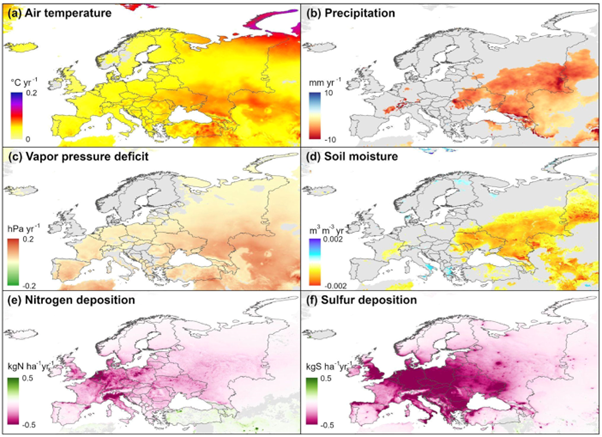
Effect of global change drivers on carbon fluxes and resilience of European forests
In this paper we synthesise current knowledge on how global change drivers (e.g., elevated CO2, drought, heatwave, nitrogen deposition, and understudied extremes) affect forest carbon fluxes (CO2 and CH4) and resilience. We identify key knowledge gaps and discuss priorities for future research and monitoring.
Key messages from the paper:
- Forest responses to climate extremes are becoming more complex and less predictable
- Forest dynamics are shaped by interacting global change drivers, making single-driver assessments insufficient for predicting ecosystem responses
- Understanding forest resilience requires long-term observations that capture the dynamic feedbacks among ecophysiological processes, soil biogeochemistry, and disturbance regimes.
The study emerged within the framework of the European COST Action CLEANFOREST, which sees the collaboration of 34 researchers from 30 different institutions in 17 countries.
COST Near Neighbour Country Factsheets 2025
Explore key facts and figures from the following nine COST Near Neighbour countries: Algeria, Azerbaijan, Egypt, Jordan, Kosovo, Libya, Morocco, Palestine and Tunisia.
These factsheets provide an overview of each country’s involvement with COST, including participation in COST Actions and the COST Open Call, networking activities, locally organised events, allocated funding, and Actions involving researchers and innovators.
COST Annual Report 2025
The 2025 Annual Report summarises the key highlights of the past year. It combines activities and figures to demonstrate how COST continues to strengthen its role in European research and innovation by connecting people, ideas and communities across borders.
The success stories illustrate what this means in practice. They show how COST Actions transform dispersed knowledge into structured collaboration and showcase the outcomes of this collaboration. Researchers build lasting networks that continue to grow. Data is shared, made accessible and reusable. New approaches are developed, tested and refined in real settings.
Many COST Actions align their efforts with European priorities. Some contribute to policy discussions. Others open pathways towards innovation or support the uptake of results beyond academia. At the same time, COST Actions help ideas to mature and partnerships to consolidate, creating the conditions for future funding and longer-term impact.
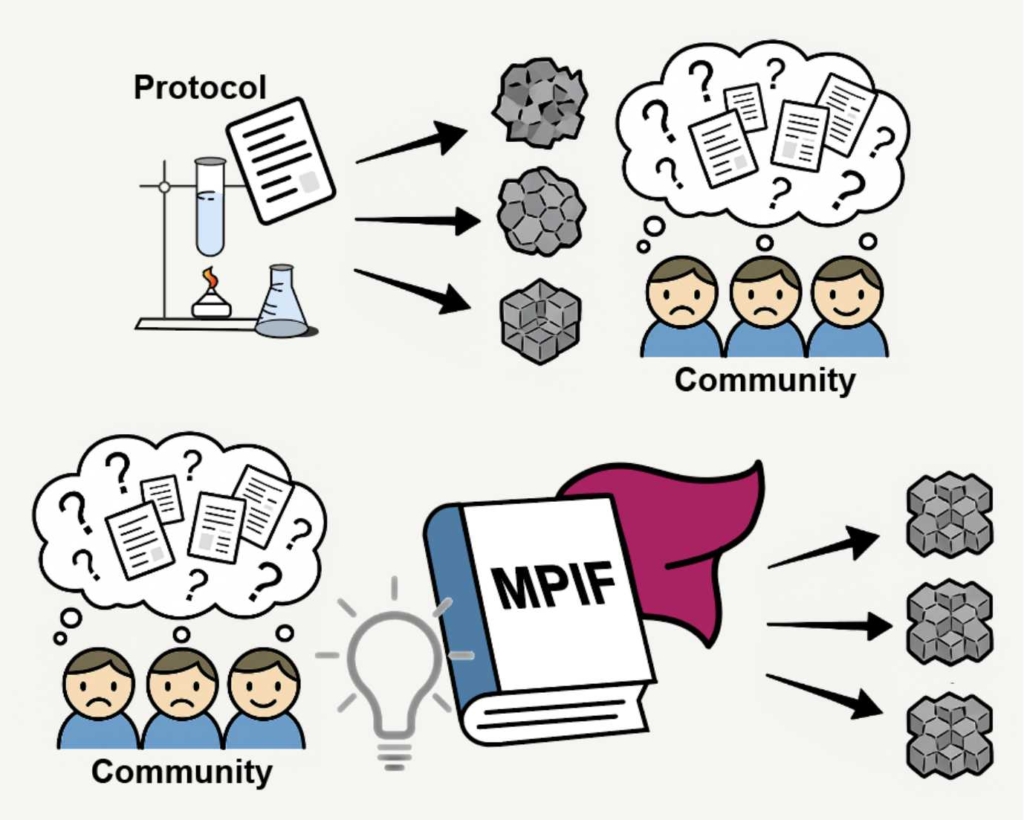
Material Preparation Information File (MPIF): A Community-Driven Standard for Reporting MOF Syntheses
DOI: 10.1002/adma.202521420
We introduce MPIF (Material Preparation Information File), a standardized format for recording materials synthesis data for MOFs and related materials. It captures detailed experimental procedures and conditions in a structured, machine-readable format, enabling consistent reporting of synthesis workflows. This improves reproducibility, transparency, and data sharing across laboratories. By establishing a common standard for synthesis reporting, MPIF aims to transform how the MOF community records, shares, and analyzes synthesis data, enabling large-scale data-driven discovery and accelerating progress toward automated and AI-assisted materials research.
COST Country Factsheets 2025
Explore key facts and figures from COST’s 41 member countries and one cooperating member.
The factsheets illustrate each country’s participation in COST Actions and networking activities, as well as the number of leadership roles held and the budget received. The data is also grouped by age and gender.
Read success stories involving researchers from the country and find out what they have to say.
The BeSafeBeeHoney Recipe Book – A global collection of honey-based recipes
Created within COST Action BeSafeBeeHoney (CA22105), this Recipe Book celebrates honey as a natural treasure and a versatile ingredient used in kitchens around the world. It brings together honey-based recipes shared by our network, alongside cultural stories that highlight how honey connects food, tradition, and sustainability.
Share your dish using #BeeHoneyHoliday (and tag @BeSafeBeeHoney on social media): https://drive.google.com/file/d/1gh7kJwiXdIdrWZDWkeJxR2TzguTlRZKg/view
Contact person for further information:
BeSafeBeeHoney Communication Team | Email: besafebeehoney@gmail.com
Science Communication Coordinator | Email: marta.leite@iniav.pt
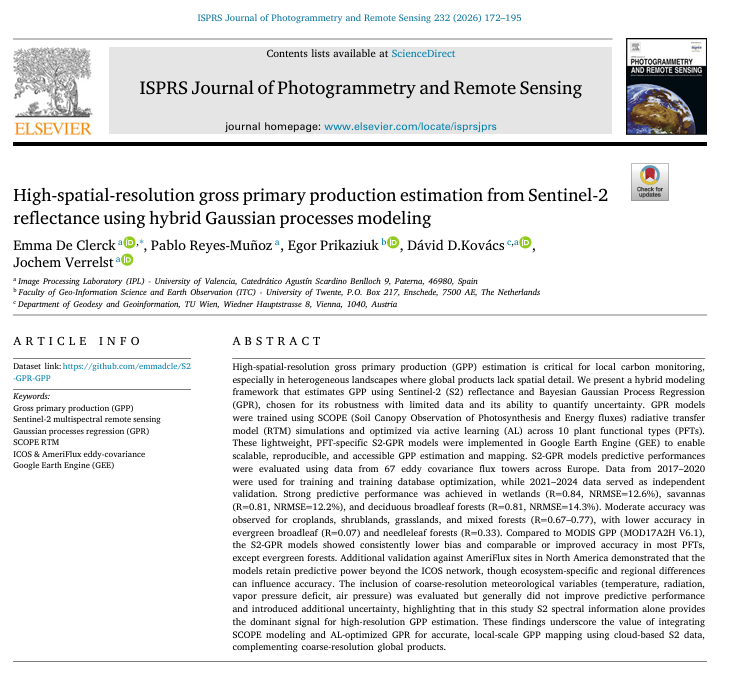
High-spatial-resolution gross primary production estimation from Sentinel-2 reflectance using hybrid Gaussian processes modeling
DOI: https://doi.org/10.1016/j.isprsjprs.2025.11.033
Journal: ISPRS Journal of Photogrammetry and Remote Sensing, Volume 232, Pages 172–195
This publication presents a new hybrid Gaussian processes approach to estimate gross primary production (GPP)—the amount of carbon plants fix through photosynthesis—at high spatial resolution using Sentinel-2 reflectance data. By combining physical knowledge with data-driven modelling, the method produces more accurate and spatially detailed GPP maps, particularly in complex forest and vegetation landscapes. The results highlight the approach’s strong potential for improving carbon cycle assessments and supporting climate- and ecosystem-related monitoring efforts.
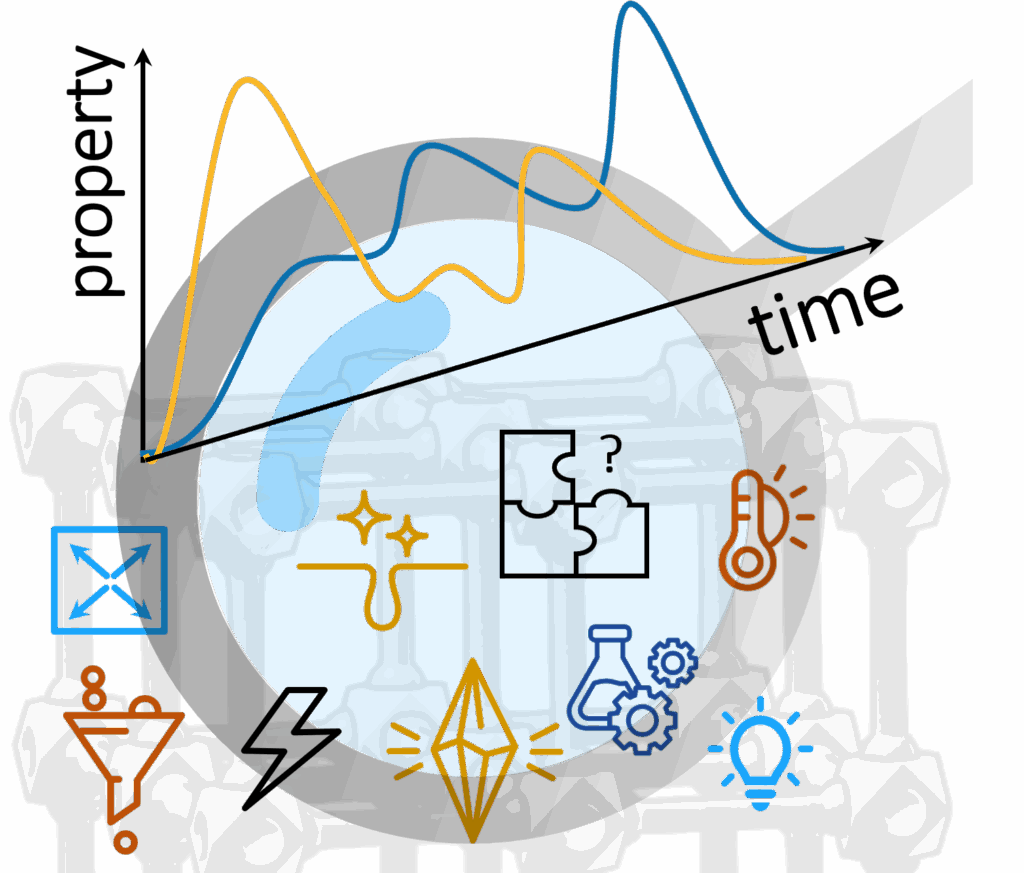
Advancements in Understanding the Physicochemical Properties of Reticular Materials: An In Situ and Operando Spectroscopic Perspective
This review highlights how in situ and operando spectroscopic and scattering techniques are advancing our understanding of reticular materials such as MOFs and COFs. By probing these porous frameworks under working conditions, researchers can track active sites, reaction intermediates, and structural dynamics during catalysis, gas adsorption, and photochemical processes. The article surveys recent progress across characterization methods, discusses how these insights inform synthesis and design, and points to opportunities for developing more efficient materials for energy and environmental applications.
Growing Ideas Through Global Networking
Guidance for researchers and innovators in Near Neighbour Countries and Third/International Partner Countries. This publication explains how to get involved in COST Actions and what opportunities are available.